Campaign finance reform is an issue that has supporters on both the left and the right. We the People are waking up and connecting the stranglehold of big money on our electoral process with the fact that we have been working harder for decades with stagnating wages and skyrocketing costs of necessities. According to Public Citizen, as of September 2025, 22 states plus Washington DC have called for a Constitutional Convention to overturn the disastrous Citizens United decision. While this route has potential, it also faces significant barriers. However, two states—ruby red Montana and mostly blue but sometimes purplish Maine—are leading the way with creative strategies that don’t involve directly overturning Citizens United.
In the early days of American corporations, states granted charters for public projects that required large infusions of capital and labor that was beyond the resources of a local jurisdiction or even the state itself. These early corporate charters were the first form of public-private partnerships: They were usually limited in both purpose, scope and time; i.e., for the building of bridges, canals and railroads, with strictly defined rights and obligations (e.g., the right to sue and be sued).
As creatures of state statute, the states had authority to regulate these corporations. In the 1819 case Trustees of Dartmouth College v Woodward (17 U.S. 518)—considered to be the foundational Supreme Court case on the nature of corporations—Chief Justice John Marshall articulated this theory: “A corporation is an artificial being, invisible, intangible, and existing only in contemplation of law…the objects for which a corporation is created are universally such as the government wishes to promote.”
However, as time went on corporations, with their cadre of lawyers and lobbyists, expanded allowed corporate activity to “any lawful purpose,” as well as granting them limited liability and perpetual lifespans. The only way to end the existence of a corporation is through revocation of its state charter. In the late 19th and early 20th century, state revocation of corporate charters was much more frequent than it has been in the latter half of the 20th and early 21st centuries. This is due to the stranglehold that wealthy individuals (the majority of corporate owners and shareholders) have over our political processes.
Two of the most infamous pro-corporate Supreme Court decisions were decided on the flimsiest of record and rationale. The first suggestion of corporate “personhood” appeared in a headnote (i.e., NOT part of the formal opinion) authorized by Justice Morrison Waite in the 1886 case Santa Clara County v Southern Pacific Railroad (118 U.S. 394), which involved the tax assessment authority of the State Board of Equalization. Waite stated, “The Court does not wish to hear argument on the question of whether the provision in the Fourteenth Amendment to the Constitution, which forbids a State to deny to any person within its jurisdiction the equal protection of the laws, applies to these corporations. We are of the opinion that it does.” With the assistance of armies of lawyers in corporate law firms, this tangential, unsupported statement thus became a cornerstone of corporate law.
The second decision was the infamous Citizens United v. Federal Election Commission, 558 U.S. 310, in 2010. Here again, the Court manufactured a “facial challenge” that was not presented by the parties, who were only requesting that publication of a documentary disparaging of Hillary Clinton be allowed within 30 days of the 2008 primary elections. The Citizens United court overturned a contrary split decision issued in 2003 (a challenge to the 2000 bipartisan Campaign Reform Act in McConnell v F.E.C., 540 U.S. 93). Previously, the Court had made a distinction between campaign expenditures (which were protected by the First Amendment as political speech) and campaign contributions. Contributions could constitutionally be limited because they presented a real danger of quid pro quo bribery. The fallacy of Citizens United was that the separation of contributions to super PACs that were “unaffiliated” with a specific candidate miraculously avoided the quid pro quo contribution problem.
The Montana Plan
Montana takes the approach of regulating state corporate charters more like they were in the early 19th century. Under the Montana Plan, (aka Transparent Election Initiative), all corporate charters issued in the state would expressly prohibit corporations chartered in Montana from making contributions to elections or ballot issues. This would not only apply to corporations chartered in Montana, but also to out-of-state corporations seeking to do business in Montana.
The Montana Plan , which will appear as a ballot initiative in the 2026 elections, reads:
“[Number] would amend Article XIII of the Montana Constitution to redefine the powers of artificial “persons,” including corporations. It defines their powers as only those the constitution expressly grants and provides that artificial persons have no power to spend money or anything of value on elections or ballot issues. It affirms that the people of Montana never intended for artificial persons to have the power to spend on election or ballot issues. [Number] provides that actions beyond those expressly granted powers are void. The initiative permits political committees to be granted the power to spend on elections and ballot issues. It allows enforcement through forfeiture of state-conferred privileges. The initiative includes a clause that ensures that valid portions of the initiative remain effective even if other parts are invalidated.”
So, how does the Montana Plan get around Citizens United? Sometime around the beginning of the twentieth century, states all but abandoned imposing limits on corporate charters. That is, nearly every corporation formed (or re-organized) since then is empowered to engage in “any lawful purpose,” without any express limits. The Citizens United decision thus applied to such fully empowered corporations. Montana is simply taking back the state’s power to limit corporate activity—a power which heretofore has NOT been overturned by the Supremes. It is past time to once again make corporations servants of the People—as exercised through state power—and not the oligarchy.
We can already hear the howls from the corporatocracy that this initiative will “kill” business in Montana. We will see what Montana voters do. If the Montana Plan is approved by Montana voters and survives the (near certain) ensuing court challenges, it could point the way for other states to follow.
Maine challenges the fallacy of “independent” contributions
In 2024, nearly 75% of Maine voters approved a ballot measure that limited contributions to super PACs (also known as “independent expenditure PACs) to $5,000. It also requires disclosure of all contributions. Not surprisingly, a couple of super PACs with the faux-populist names of Dinner Table Action and For Our Future (along with various associated individuals) challenged the new (real populist) law in a Maine Federal District Court. The District Court tossed the case based on the logic of Citizens United. The Defendants—officials from the Maine Commission on Government Ethics and Election Practice, the Maine Attorney General, Equal Citizens (the group who promoted the ballot initiative), and various associated individuals appealed. The case is now in the US First Circuit Court of Appeals, Case No. 25-1705.
The case has generated a lot of interest, along with a plethora of amicus briefs. The Chamber of Commerce submitted an amicus brief in the trial court. At the Appellate Court, amicus briefs for Defendant-Appellants have been submitted by the Campaign Legal Center, the Brennan Center for Justice, Citizens for Responsibility and Ethics in Washington (CREW), Demos, and Mainers for Working Families (represented by Free Speech for People). Ironically a friendly (to the People) amicus brief was also submitted by a group of five billionaires (including Mark Cuban) arguing that large contributions to super PACs can facilitate corruption.
The Defendants’ arguments hark back to earlier campaign finance jurisprudence—(Buckley v Valeo, 424 U.S. 1 (1976) and McConnell v F.E.C., 540 U.S. 93 (2003)—that distinguished campaign expenditures (which directly implicate free speech and are subject to exacting scrutiny) and contributions, which are subject to a lesser “closely drawn” scrutiny due to the government’s interest in preventing both corruption and the appearance of corruption. This distinction was never expressly overruled in Citizen’s United; rather, it was (naively, in the opinion of many, this writer included) presumed that the lack of coordination between candidates and super PACS magically prevented the possibility of quid pro quo.
The Defendants point to the Menendez case (discussed infra) and other post-Citizens United bribery cases that expose the fallacy of this logic. Dinner Table Action’s three top contributors are other PACs, all funded almost entirely by the Concord Fund (fka the Judicial Crisis Network), which is connected to a network of groups led by Leonard Leo and the Federalist Society. None of these super PACs disclose their funders, which makes it nearly impossible to trace the money. Indeed, contributions to a super PAC—like contributions to any other third party made by a donor at the behest of the candidate—may be part of a quid pro quo corrupt agreement even if the super PAC itself is ignorant of the corrupt agreement. The Defendants cite 2024 F.E.C. Advisory Opinions permitting PACs to coordinate canvassing and literature scripts with candidates and even allowing candidates to headline super PAC fundraising events to solicit contributions.
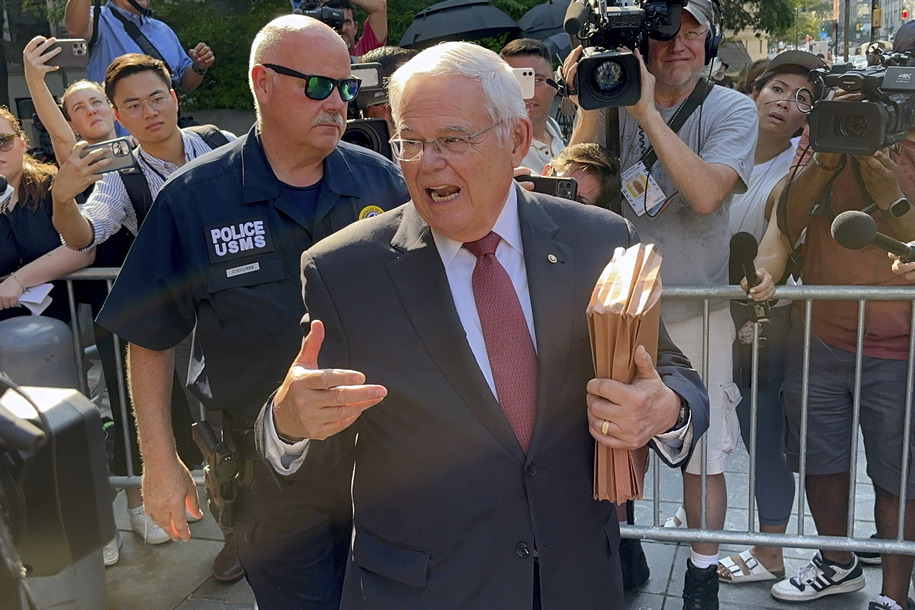
Most of us are (at least vaguely) aware that former U.S. Senator (D-NJ) Bob Menendez was convicted of bribery, wire fraud and extortion in July 2024. Although Menendez attempted to shift all the blame onto his wife (who was also convicted for similar crimes in April 2025) and described the gold bars and cash found in his home as “gifts,” a Manhattan jury found him guilty on all counts. What many folks may not realize is that Menendez had been previously indicted on various corruption charges in 2015. Although most of these charges were dismissed, Judge William Walls did not dismiss charges related to super PAC contributions that were solicited by Menendez. The case went to trial in 2017, but ended in a mistrial because the jury could not come to a unanimous verdict.
In the earlier case, Menendez attempted to argue that Citizens United protected a $700,000 donation to Senate Majority Super PAC from one of Menendez’s cronies. In his decision allowing the bribery charge to go forward, Judge Walls argued that there is no First Amendment right to engage in quid pro quo bribery, and so Citizens United did not apply. “Defendants are correct that attempts to influence a public official through speech alone are protected. But the Constitution does not protect an attempt to influence a public official’s acts through improper means, such as the bribery scheme that has been alleged in this case. The government has adequately alleged that Melgen made contributions in an effort to control the exercise of Menendez’s official duties, and the truth of these allegations is a question of fact.”
This decision suggests that a donation to a super PAC can constitute federal criminal bribery (i.e., a quid pro quo) if there is sufficient evidence to prove it. Some legal pundits suggested that this created a direct conflict with the logical fallacy in Citizens United that independent expenditures were not inherently corrupting. Others argued that there was no conflict so long as a prosecutor was able to “bring the receipts” to prove an agreement with a candidate to make a contribution to a super PAC. Paul Ryan, senior counsel at the Campaign Legal Center remarked that, “Judge Walls stated the obvious. This is something we’ve all known for years. It was predictable that when super PACs were created in 2010 that contributions could lead to corruption.”
The arguments in these challenges focus on the interest of the state/government in preventing corruption of public officials. What tends to get less scrutiny (due to a paucity of precedent addressing it) is the threat posed to democracy itself: The involvement of super PACs in an election is often more outcome-determinative than the candidate committees themselves. In 2024, some 97.94% of contributions to super PACs came from the top 1% of donors. In Maine, the Democratic Governor’s Association contributed $9.2 million, which was almost wholly funded by Better Maine PAC. The Maine Families PAC contributed $2.9 million, which was wholly funded by a single individual in New York. Last but not least, are the hundreds of millions of dollars flowing through super PACs that funded the 2024 election of Donald Trump, including $260 million from Elon Musk—whose companies have enjoyed both regulatory favors and contracting advantages from the Trump administration. While quid pro quo corruption is the most obvious concern, the huge sums flowing into elections through super PACs come from a small number of obscenely wealthy individuals. Whether criminal-level corruption ever happens or not, the voice of “the People” never gets heard among the flood of big money in elections.
The attorneys representing Mainers for Working Families, along with Harvard Law School Professor Larry Lessig, are optimistic about the Maine case’s chance of success. Lessig argues that Bob Menendez actually “did the thing that Citizens United said could not happen, which proved false” the fundamental assumption of Citizens United—that bribery could not happen through the independent expenditures of a super PAC. In spite of the optimism, Lessig nonetheless warns that it is “easy for this court to do the wrong thing…Many people are cynical about the Supreme Court, but this would require them to extend their own decision beyond logic.” (And, as we have seen, the Federalist Six have no compunction to follow either logic or precedent.)
Both the Maine case and the Montana Plan are worth following. These days we need all the hope we can find. At the same time, we need to keep up the ongoing efforts to overturn Citizens United. Wherever it comes from, We the People need to change the narrative: Money is not speech, it is power—power of the oligarchy to drown the voices of the People and kill or corrupt democracy.